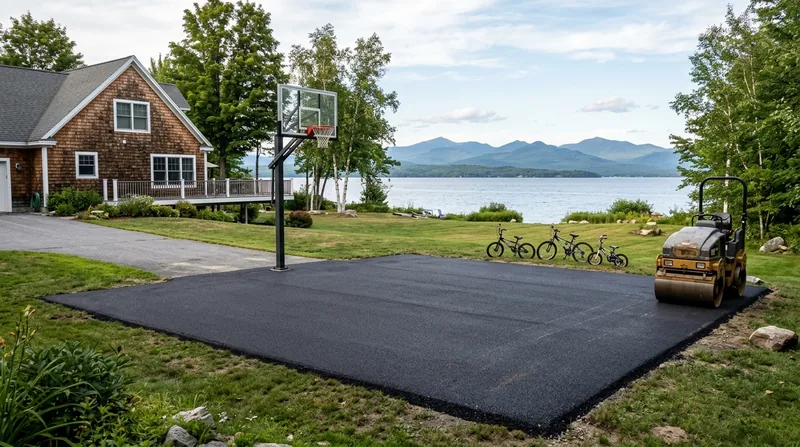




Sports Court & Path Paving in Burlington means building a dead-flat asphalt surface that holds true through Vermont's brutal freeze-thaw cycle, so your tennis court, pickleball base, or backyard path stays level and playable year after year. Burlington's Hill Section and University District sit on sloped glacial till that heaves hard in spring, and the New North End and South Burlington suburbs have decades of frost damage beneath aging driveways. A properly built court or path needs a deep base structure and expert grading to shed water away from the asphalt, because standing water in the base is what kills a court in one hard winter. We build the foundation first, then pave the acrylic-ready surface on top, so your court survives the four to five feet of frost that drives up from the ground every March and April. Call us at (802) 214-7338 for a free estimate, or read more about our asphalt driveway paving and installation work to understand how we approach base preparation.
Why Sports Court & Path Paving Matters in Burlington's Climate
A backyard court or path is not a driveway. It must be dead-level for acrylic paint systems to adhere properly and for the ball to roll true, and it must shed water aggressively so that freeze-thaw cycles do not crack and heave the surface. Burlington gets roughly 80 inches of snow and four to five feet of frost penetration each winter, which means water trapped in a weak base will expand and lift the asphalt. Spring mud season and the 2023 flood events showed how fast mountain rain can wash out a poorly graded surface. A court or path built on a solid base with proper drainage stays playable and crack-free for years, while one built on inadequate grading fails in the first hard freeze.
- We excavate and prep the base to exact grade, removing soft soil and installing compacted stone so water drains away from the asphalt.
- We pave to dead-flat specifications so acrylic color systems bond evenly and the court plays true.
- We proof-roll and inspect the base before we lay asphalt, catching weak spots before they become heaves.
- We size the court or path to your exact dimensions and slope it so rain runs off immediately.
A court built this way holds its surface and stays playable through the harshest Vermont winters.
Key info: Burlington's Hill Section and the South End have many historic homes with tight rear yards where a tennis or pickleball court fits perfectly. We grade and pave courts in tight spaces where water management is critical because of the surrounding terrain and the proximity to foundations and septic systems.
For more on how proper grading protects your property, see our gravel driveway installation and grading page.
How We Build a Court or Path That Lasts: The Burlington Standard
A court or path is built in layers, from the ground up. We start with a site visit to understand the terrain, water flow, and proximity to structures. We then grade the subgrade, install a compacted stone base, and pave the asphalt to a precise level. The entire process takes planning and precision because a single low spot will collect water and cause failure. We work within Vermont's May-through-October paving window, so scheduling is tight and we book jobs in order.
- We visit the site and measure the footprint, checking for water flow, soft spots, and drainage issues.
- We excavate to the proper depth and compact the subgrade so it will not settle under the weight of the court.
- We install a deep stone base, typically 4 to 6 inches of compacted aggregate, and proof-roll it to verify density.
- We pave the asphalt layer in a single lift, maintaining dead-level tolerance for acrylic paint systems.
- We grade the perimeter so water runs away from the court and does not pool at the edges.
The result is a court that stays true through spring thaw and heavy rain.
Local example: A homeowner in Williston wanted a pickleball court in a rear yard with a high water table. We dug down to find the seasonal water level, installed a thicker base with side drainage, and paved the court 8 inches above grade so water flows away naturally. The court has stayed dry and level through two winters.
Learn more about our approach to asphalt resurfacing and overlay, which uses the same base-first philosophy.
| Approach | Description | Best For |
|---|---|---|
| Full Excavation and Base Build | Remove old surface, excavate soft soil, install 4 to 6 inches of compacted stone, then pave new asphalt to dead-level. | New courts, paths, or sites with poor drainage or weak subgrade. |
| Overlay on Existing Base | If the existing base is sound and the subgrade is stable, mill the old surface and pave a new layer to restore level and playability. | Courts with a solid foundation but surface cracking or minor settling. |
| Grading and Drainage Retrofit | Improve existing court by regrading perimeter, adding drainage swales, or raising the court surface to shed water better. | Courts with water pooling, edge cracking, or seasonal moisture problems. |
| Tennis and Pickleball Surfaces | Pave to acrylic-ready dead-flat tolerance, with color coats and line marking by specialized contractors we recommend. | Residential and small commercial courts where acrylic paint systems are the finish. |
Sports Court and Path Paving Cost in Burlington: What to Expect
Sports court and path paving costs depend on the size of the court, the condition and stability of the existing ground, how much excavation and base work is needed, and access for equipment. A small backyard pickleball court starts around $8,500 to $12,000, while a full tennis court or a large path system runs higher. The biggest cost driver is the base, because weak ground or poor drainage means you have to excavate deeper, remove more soil, and install thicker stone. A site with good drainage and stable subgrade costs less than one where we have to build a raised court with side swales. A free on-site estimate is the only way to know, because every yard in Burlington has different soil conditions, water flow, and access.
Factors that move the price up include:
- Soft or wet subgrade that requires deeper excavation and thicker base installation.
- Poor drainage or high water table, which may need drainage swales, perimeter grading, or a raised court surface.
- Proximity to trees, structures, or utilities that limit access for grading equipment.
- Large court size or complex shape that requires more material and labor.
- Removal of old asphalt or pavement that must be hauled away.
We give you a written estimate with tonnage and thickness specs so you know exactly what you are paying for. See our full pricing page for more detail on how we quote and what a typical court or path costs in the Burlington area.
Sports Court and Path Paving Near Me: What Burlington Homeowners Should Know When Hiring
A court or path is a long-term investment, so hiring the right contractor matters. We are a local Burlington shop with local plates and a local address, which is the strongest signal that we will be here to stand behind the work. Avoid unsolicited door-to-door offers, crews with out-of-state plates, quotes with no written contract or tonnage specs, and prices that seem too good to be true. A reputable contractor will visit your site, ask about drainage and soil conditions, and give you a detailed estimate in writing. Check references, verify the contractor is fully insured, and ask for proof of insurance coverage. If your court is in a homeowners association, check the architectural guidelines first, because some HOAs have rules about materials and colors. Burlington's building department can tell you whether you need a permit for a court or path, and in some cases a municipal culvert or stormwater review is required. Call us for a free estimate at (802) 214-7338, and we will walk you through the process and answer any questions about permits or site conditions.
Key things to verify when hiring any contractor, including us:
- Ask for a written estimate that includes the depth of asphalt, the thickness and type of base material, and the total tonnage.
- Verify the contractor is fully insured and ask to see a certificate of insurance naming your property.
- Ask for references from recent court or path projects in the Burlington area.
- Confirm that the contractor will help you navigate any local permitting or HOA approval.
- Get a timeline in writing, because paving only happens May through October in Vermont.
A court built by a local contractor who knows Burlington's soil and climate will outperform one built by a travelling crew, because the base work is everything.
Sports Court & Path Paving in Burlington: Pricing Guide
| Service | Price | Details |
|---|---|---|
| Small pickleball court (30x60 ft) | Starting at $8,500 | Includes base excavation, 4-inch compacted stone, 2-inch asphalt, grading for drainage, and site cleanup. |
| Tennis court or large path (60x120 ft or equivalent) | Starting at $15,000 | Full site work including subgrade prep, 4 to 6-inch stone base, 2-inch asphalt, perimeter grading, drainage swales where needed. |
| Court with poor drainage or high water table | On estimate | Requires deeper excavation, thicker base, possible raised court surface, and side drainage, so site visit is required before pricing. |
| Overlay on existing stable base | Starting at $5,000 | Mill old surface, install 1.5 to 2-inch new asphalt, restore level, includes grading adjustment for water runoff. |
| Travel and estimate | Free | No charge for site visit and written estimate. Response within 24 hours at (802) 214-7338 for Burlington and surrounding areas. |
Indicative pricing, the exact cost depends on square footage, finish, and site access. Free personalized estimate within 24h at (802) 214-7338.


