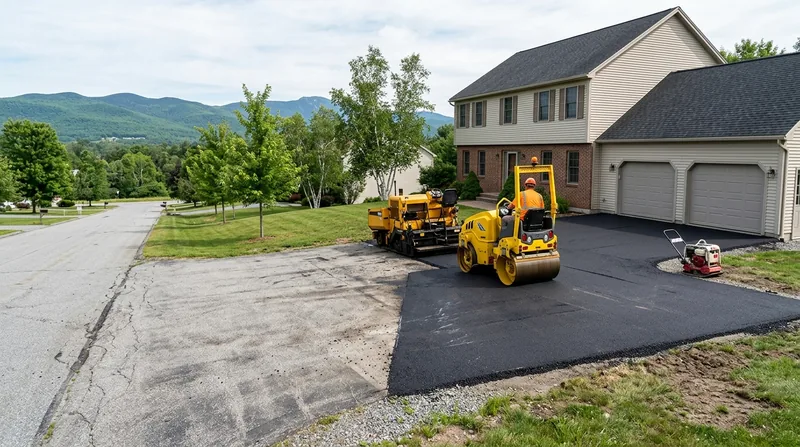




Burlington's driveway surfaces age hard. Frost heaves four to five feet deep through dense glacial till and Champlain Sea marine clay, and the short paving season from May through October means every spring brings mud, cracks, and edge failure. Asphalt resurfacing and overlay is the practical middle path: a new 1.5 to 2 inch surface course over a structurally sound base, without the cost and disruption of full replacement. We level and repair cracks, edge-mill at the garage and street so the overlay ties in flush, and we tell you plainly if frost has broken the base before you spend. For the Victorians and Colonials on the Hill Section and the Old North End, for the post-war capes and ranches aging out across South Burlington and Williston, and for the HOA driveways in Essex Junction and Colchester that are failing together, overlay is the honest choice when the foundation still holds.
Why Asphalt Resurfacing and Overlay Matters in Burlington's Climate
Vermont's freeze-thaw cycle is relentless. Water enters small cracks in the asphalt surface, freezes, expands, and breaks the pavement apart. By late March and April, when the frost comes out and the base softens, the surface has splintered into alligator cracks and edge failures. Patching these cracks individually throws money away once they cover more than thirty to forty percent of the surface. An overlay addresses the real problem: it seals the old surface and gives you a new wearing course before the base fails completely.
- Extends the life of a sound base by ten to fifteen years without full replacement.
- Costs roughly sixty to seventy percent less than tearing out and repaving the entire driveway.
- Restores proper drainage and eliminates standing water that accelerates base failure.
- Works on residential driveways, parking lots, and private roads across the Champlain Valley.
- Must be installed between May and October when temperatures allow proper compaction and curing.
If your driveway shows widespread alligator cracking or the base has heaved and broken through in multiple spots, an overlay will not hold, and full replacement is the only answer. We inspect the base before proposing work, and we say so if the money belongs in replacement instead.
Local example: A 1980s ranch in South Burlington with a two-car drive showing moderate cracking and some edge spalling is a textbook overlay candidate. The base is still firm, the slope drains, and a 1.75 inch overlay will restore it for another decade. Replacement would run two to three times the cost and would disrupt the driveway for five to seven days.
How Asphalt Resurfacing and Overlay Works: The Process in Burlington
An overlay is not a patch job. We begin with a site inspection to measure the driveway, check the base for soft spots, and identify edge failures and drainage problems. We then prepare a written estimate with tonnage and thickness specified so you know exactly what you are getting. The work itself follows a strict sequence: edge-milling at the garage and street apron, crack repair and patching, tack coating, and finally the new asphalt course rolled and compacted to density. The driveway is ready for light traffic in 24 hours and full use in 48 hours.
- We inspect the base for soft spots, frost heave, and drainage problems before quoting.
- Edge-mill the old surface at the garage foundation and street to tie the overlay in flush.
- Repair and patch cracks and spalls in the old surface so the new layer bonds properly.
- Apply a tack coat so the new asphalt adheres to the old surface.
- Roll and compact the new 1.5 to 2 inch surface course to proper density and smoothness.
- Cure for 24 to 48 hours before the driveway is open to traffic.
The entire job typically runs three to five days depending on the size of the driveway and weather. New asphalt must not be sealed for the first six to twelve months while it cures and hardens. Many homeowners make the mistake of sealing too early, trapping moisture and causing premature failure.
Local example: A triple-decker in the Five Sisters neighborhood of Burlington with a narrow shared drive showing moderate cracking and edge spalling benefited from a 1.5 inch overlay in June. The work took two days, the base was sound, and the driveway was ready for use by the weekend. Compare that to a full replacement, which would have meant three to four weeks of disruption and a much larger bill.
See our driveway repair page for guidance on when patching makes sense and when overlay is the better choice.
Asphalt Resurfacing and Overlay Methods
| Approach | Description | Best for |
|---|---|---|
| Standard Overlay | 1.5 to 2 inch new asphalt course over a structurally sound base, with edge-milling and crack repair. | Residential driveways and parking lots with moderate cracking and a firm foundation. |
| Mill and Overlay | Milling removes 1 to 2 inches of old asphalt before the new surface is laid, improving drainage and reducing thickness buildup. | Driveways with multiple old layers, poor drainage, or where new height must be controlled. |
| Leveling Course Overlay | A thick overlay (2 to 3 inches) applied over a base course to correct minor settling, ruts, or grade issues before the final surface. | Parking lots and private roads with uneven settling but a sound structural base. |
| Full-Depth Replacement | Complete removal of old asphalt and base, base preparation, and new construction from the ground up. | Driveways with widespread alligator cracking, soft or failed bases, or severe frost heave. |
Overlay is the right choice when the base is sound and the surface damage is confined to the top layer. If you see alligator cracking over more than thirty to forty percent of the driveway, the base is likely compromised, and an overlay will not hold. We inspect the base on site and recommend milling and removal or full replacement when that is the honest answer.
Asphalt Resurfacing and Overlay Cost in Burlington: What to Expect
Overlay pricing starts at around $4 per square foot for a standard 1.5 to 2 inch surface course on a residential driveway with a sound base and straightforward access. A typical two-car driveway of 500 to 600 square feet runs $2,000 to $2,400 before any additional work. The real cost drivers are the size of the driveway, the extent of base repair and crack patching needed, edge-milling complexity, and whether the old surface needs to be milled away first.
- Driveway size is the largest factor: a small residential driveway costs less per square foot than a large parking lot.
- Base repair and crack patching add cost if the old surface shows significant spalling or soft spots.
- Edge-milling at the garage and street apron adds labor but ensures a flush, professional tie-in.
- Milling away old asphalt before the overlay improves drainage and reduces thickness buildup but adds $0.50 to $1.00 per square foot.
- Parking lots and private roads carry higher tonnage and longer cure times, so the per-square-foot cost is lower but the total bill is larger.
The only reliable way to know your cost is to get a written estimate on site. We measure the driveway, inspect the base, and specify thickness and tonnage so you know what you are paying for. We also provide a free estimate within 24 hours at (802) 214-7338 with no obligation to book. Compare at least two or three estimates from local contractors so you can see where the price differences come from: thickness, tonnage, base repair, or edge-milling.
Asphalt Resurfacing and Overlay Near Me: What to Look for When Hiring a Contractor in Burlington
The paving trade attracts itinerant crews who show up unsolicited, offer a price that is too good to be true, ask for a large cash deposit, and disappear. Protect yourself by hiring a local contractor with a verifiable address, local phone number, and a reputation in the community. Check that the estimate includes thickness, tonnage, and the scope of base repair and edge-milling. Ask for references from recent jobs in Burlington or South Burlington, and verify that the contractor is fully insured.
- Confirm the contractor is fully insured and can provide a certificate of insurance before work begins.
- Get a written estimate that specifies thickness, tonnage, and the scope of crack repair and edge-milling.
- Ask for references from at least two recent jobs in the Burlington area and follow up with those homeowners.
- Check that the contractor has a local address and local phone number, not out-of-state plates or a cell phone with no office.
- Verify that any driveway extension or apron work complies with local zoning and stormwater rules before you sign.
- Confirm that HOA architectural standards permit the overlay if you live in a master-planned community.
If you are unsure about permitting or HOA requirements, contact the Burlington City Planning and Zoning Office or your HOA board before requesting estimates. Overlay work is straightforward and usually does not require a permit, but it is worth checking. Call us at (802) 214-7338 to discuss your driveway and get a free estimate with no obligation.
Asphalt Resurfacing & Overlay in Burlington: Pricing Guide
| Service | Price | Details |
|---|---|---|
| Residential driveway overlay | Starting at $4/sq ft | 1.5 to 2 inch new surface on a sound base, includes edge-milling and crack repair for proper tie-in |
| Mill and overlay | Starting at $5.50/sq ft | Milling removes old asphalt before new layer, improves drainage and controls height buildup on thick old surfaces |
| Parking lot or private road overlay | Starting at $3.50/sq ft | Larger square footage reduces per-unit cost, includes base inspection and repair of soft spots or settling |
| Base repair and crack patching | On estimate | Extent of spalling, soft spots, and edge failure varies by site, inspected on location before quoting |
| Travel | Included | No separate charge in Burlington and surrounding areas, included in the total estimate |
| Free estimate | No charge | Response within 24 hours, site inspection, written quote with tonnage and thickness specified |
Indicative pricing, the exact cost depends on square footage, finish, and site access. Free personalized estimate within 24h at (802) 214-7338.


