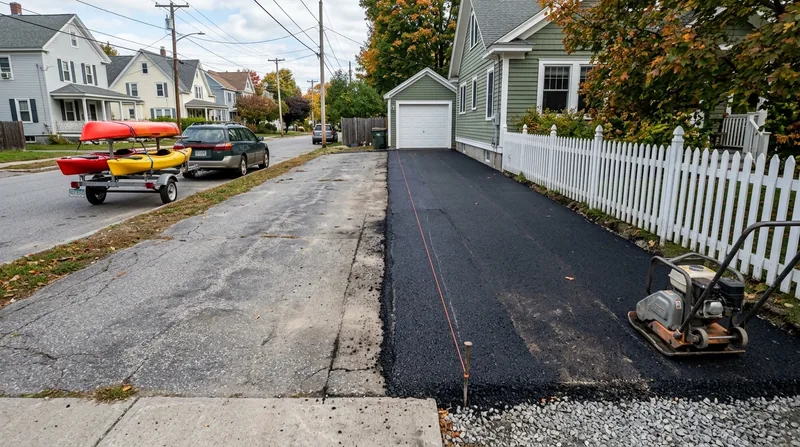




Burlington's hillside neighborhoods, tight Old North End drives, and sprawling post-war suburbs all share one constraint: space. The Hill Section and University District hold 1800s Victorians on steep lots with narrow side drives carved into grade. The Old North End and Five Sisters pack triple-deckers and duplexes with shared lanes barely wider than a plow truck. South Burlington and Colchester ranches sit on lots where the third car, the snowplow, or the RV has nowhere to go. Driveway extensions, widening and aprons in Burlington solve that problem without tearing out what works. We add parking pads for seasonal vehicles, widen tight hillside drives to meet modern truck and SUV widths, and tie new asphalt seamlessly into existing pavement with milled joints that hold. Small-footprint jobs built to full compaction standards so the new section lasts as long as the original.
The Champlain Valley terrain works against narrow drives. Dense glacial till and marine clay over ledge rock hold water and heave hard under frost. Frost cycles four to five feet deep, and 80 inches of annual snow mean plow trucks and sand and salt from November through April. A drive that was adequate in 1985 becomes a liability when a modern plow or an RV tries to use it. Widening and extensions are not luxuries here, they are practical answers to the weight and width of modern vehicles and the seasonal demands of Vermont winters.
We measure on site, specify tonnage and depth, and tie every extension into the existing asphalt with a milled joint that sheds water and prevents the cracking that kills weak connections. Whether you need a small pad for the boat or a full third-car parking area, we build it to the same compaction standard as a new driveway so it holds through the thaw and the next fifteen years of freeze-thaw cycles.
Why Driveway Extensions and Widening Matter in the Burlington Area
Tight driveways are a signature of Burlington's older neighborhoods and many of its post-war subdivisions. The Hill Section and the Five Sisters were built for carriages and single-car garages. Modern SUVs, trucks, and seasonal vehicles do not fit those footprints. A driveway extension or widening solves the immediate problem, but it also protects your home's value and your foundation. When a plow truck or a loaded RV has to drive on grass or gravel shoulder because the drive is too narrow, water pools at the edge and frost heaves damage the base. Widening the drive to full width prevents that edge failure and extends the life of the entire surface.
- We add parking pads for third cars, boats, RVs, and seasonal storage without compromising the existing driveway structure.
- We widen hillside drives in the Hill Section and University District to accommodate modern truck and SUV widths safely.
- We build seamless milled joints between new asphalt and existing pavement so water sheds cleanly and no cracking forms at the seam.
- We grade and compact the base to the same standard as a new driveway so extensions hold through fifteen years of Vermont freeze-thaw cycles.
- We help homeowners navigate local permitting and culvert or apron rules that vary by neighborhood and municipality.
A well-built extension protects your driveway investment and prevents the edge failure and frost heave that make narrow drives crumble in spring.
Key info: Burlington's building department and South Burlington's public works office both regulate driveway aprons and culvert requirements. Extensions in the Hill Section and University District may need a curb-cut permit if they affect municipal right-of-way. Verify local rules before you plan the work. We help you navigate permitting, but the final decision rests with your town. Call (802) 214-7338 to discuss your lot and your local requirements.
For more on how we handle permitting and local rules across Greater Burlington, see our Private Road and HOA Paving page, where we cover the same municipal coordination for shared lanes and association-governed properties.
How We Build Driveway Extensions and Widening in Burlington
Extending or widening a driveway is not a patch job. It requires the same base preparation, compaction, and depth as a new driveway. We start with a site visit to measure the existing pavement, assess the grade and drainage, and plan the milled joint that will tie the new section seamlessly into the old. We confirm local permitting rules with your town, arrange a Vermont 811 utility locate to mark underground lines, and schedule the work during the hot-mix season (May through October in this climate). Every extension is built to full-depth specifications with proper compaction so it lasts as long as the original surface.
- We measure your existing driveway and plan the extension to match the width and slope of the original surface.
- We call Vermont 811 to mark buried utilities and gas lines before any excavation begins.
- We mill a seamless joint into the existing asphalt so the new section ties in cleanly and water sheds properly.
- We grade and prepare the base with proper drainage so frost heave and water pooling do not undermine the extension.
- We compact the base and asphalt to the same density standard as a new driveway so the extension holds through seasonal freeze-thaw cycles.
- We verify final grade, thickness, and tonnage so you have a written record of what was installed.
The milled joint is the detail that separates a solid extension from one that cracks within a year. We mill a shallow groove into the existing pavement, fill it with new asphalt, and compact it so the two surfaces bond and move together through winter.
Example: A homeowner in the Hill Section needed to widen a 12-foot driveway to 16 feet to fit modern plow trucks and a second vehicle. We milled a 6-inch joint into the existing 22-year-old asphalt, graded the adjacent soil to match the existing slope, built a compacted base, and poured 2.5 inches of hot mix with a seamless joint. The extension cost $2,400 and took one day. Two winters later, no cracking at the seam, and the plow truck fits without running on the shoulder.
See our Asphalt Driveway Paving and Installation page for more detail on base preparation and compaction standards that apply to extensions as well.
| Approach | Description | Best for |
|---|---|---|
| Small parking pad extension | Add 8 to 12 feet of new asphalt with milled joint and full base preparation. Includes grading, compaction, and tonnage spec. | Third-car parking, RV or boat storage, seasonal vehicle overflow in neighborhoods where space is tight. |
| Driveway widening | Extend one or both sides of an existing drive to full width. Milled joint ties new and old asphalt. Base graded to prevent edge heave. | Hillside drives in the Hill Section or University District that are too narrow for modern trucks or plow equipment. |
| Apron or turnaround extension | Widen or lengthen the apron at the street or add a turnaround pad at the end of a long drive. Includes curb-cut or apron permitting coordination. | Steep driveways that need a wider turnaround for trucks or emergency vehicles, or aprons that need curb-cut approval. |
| Slope and drainage rebuild | Extend the drive while regrading the surrounding soil and culvert or swale to manage spring melt and storm runoff properly. | Extensions in low-lying areas or near wetlands, or where the 2023 flood showed how fast mountain rain can wash out a weak drive. |
Driveway Extensions, Widening and Aprons Cost in Burlington: What to Expect
A small parking pad extension in Burlington starts at $1,800 and covers basic grading, a compacted base, milled joint work, and 2.5 inches of hot-mix asphalt for a pad roughly 12 by 16 feet. Widening an existing driveway costs more because it requires milling the existing edge, grading adjacent soil, and building a full base on a longer run. A full-width widening of a 60-foot driveway from 12 to 16 feet typically runs $3,200 to $4,500 depending on grade and soil conditions. Apron extensions, turnarounds, and slope rework add cost if culvert or drainage work is needed. The biggest variables are access (tight hillside lots cost more to prepare), existing soil condition (clay-heavy sites in the Five Sisters or South End need more base work), and whether the extension is a simple pad or a slope rework with drainage.
Get two or three estimates before you commit. Ask each contractor for a written tonnage and depth spec so you can compare apples to apples. A legitimate estimate includes the base depth, the asphalt thickness, the tonnage of material, and the milling or joint work. If an estimate omits those details, ask why. We provide a written estimate with full specs at no cost within 24 hours.
See our full pricing page for more detail on how we estimate extensions and widening work across the Burlington area.
Driveway Extensions, Widening and Aprons Near Me: What Burlington Homeowners Should Know When Hiring
Hiring a paving contractor for an extension or widening is a straightforward process if you know what to look for. Start by asking any contractor whether they are fully insured and whether they carry workers compensation. Ask for references from jobs in your neighborhood, the Hill Section, South Burlington, or Colchester, so you can see how they handle tight lots and milled joints. Get a written estimate that includes base depth, asphalt thickness, and tonnage. Ask whether they will mill the joint into your existing asphalt or leave a cold seam that will crack. Call your local building department to confirm whether you need a permit for the extension. In some Burlington neighborhoods a simple pad does not require approval, but a full-width widening or an apron extension may. If your property is in an HOA, check the architectural rules to see whether the new asphalt color or the extended footprint needs approval. Ask the contractor how they will handle drainage so water does not pool at the edge and freeze in winter.
- Verify that any contractor you hire carries full insurance and workers compensation before they start work.
- Get a written estimate that specifies base depth, asphalt thickness, tonnage, and milling or joint work so you can compare bids accurately.
- Ask for references from similar jobs in Burlington or nearby towns and call those homeowners to ask about the quality of the milled joint and how the extension has held up.
- Call your town building department to confirm whether your extension needs a curb-cut, apron, or culvert permit before you schedule work.
- If you live in an HOA community in Colchester, South Burlington, or Williston, check the architectural guidelines to see whether the extension needs association approval.
- Avoid any contractor who offers to start immediately, demands a large cash deposit, or quotes a price per square foot without seeing the site and understanding the base and drainage conditions.
A local contractor with a local address and local plates is the strongest trust signal in this trade. The historic fraud in paving is the itinerant door-to-door crew with out-of-state plates and a story about leftover asphalt from a job nearby. We have been in Burlington since 2011 and we operate from a local address. Call us for a free estimate and ask any question you have about how we build extensions and how they hold up through Vermont winters.
Driveway Extensions, Widening & Aprons in Burlington: Pricing Guide
| Service | Price | Details |
|---|---|---|
| Small parking pad extension | Starting at $1,800 | Includes grading, base prep, milled joint, and 2.5 inches of hot mix for an 8 by 16 foot pad |
| Driveway widening | Starting at $3,200 | Full-width extension of an existing driveway, milled joint, base rebuild, and compaction to match original depth |
| Apron or turnaround extension | Starting at $2,400 | Widen or lengthen an apron at street or add turnaround pad, includes permitting coordination with town |
| Slope and drainage rework with extension | On estimate | Extensions with culvert work, swale regrading, or complex drainage need site assessment before pricing |
| Travel and setup | Included | No separate mileage fee for work in Burlington, South Burlington, Colchester, Williston, and surrounding towns |
| Free written estimate | No cost | Full tonnage and depth spec provided within 24 hours, call (802) 214-7338 to schedule site visit |
Indicative pricing, the exact cost depends on square footage, finish, and site access. Free personalized estimate within 24h at (802) 214-7338.


