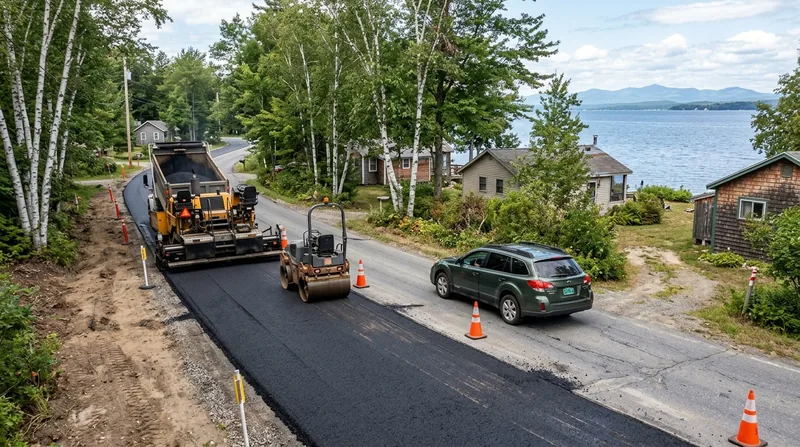




Private Road & HOA Paving in Burlington keeps shared lanes, townhome drives, and subdivision streets moving safely through Vermont's harshest seasons. Burlington's hillside neighborhoods, from the Victorian-era Hill Section to the post-war ranch subdivisions of South Burlington and Colchester, depend on reliable shared pavement. The Champlain Valley's dense glacial till and marine clay, combined with four to five feet of frost heave and 80 inches of annual snow, puts constant stress on the asphalt that serves multiple households. A single contract with board-ready documentation, phased scheduling that respects resident access, and pricing built around HOA reserve studies means you get the scale work most driveway crews cannot staff. We have handled private roads and HOA streets across the Burlington area since 2011, and we understand that one pothole affects dozens of homes, and one resurfacing decision affects the association's budget for years.
Why Private Road & HOA Paving Matters in Burlington's Aging Subdivisions
Burlington's residential landscape is split between historic walkable neighborhoods and post-war suburban development. The compact five-sisters and triple-deckers of the Old North End share tight rear pads and narrow drives; the New North End and South Burlington hold 1960s capes and raised ranches whose driveways were installed 40 to 60 years ago and are now failing together. Beyond town, newer HOA subdivisions in Williston, Milton, and Hinesburg face the same problem: dozens of homes share one or two main roads, and when the pavement fails, it fails for everyone at once. Spring frost heave from the deep freeze, mud season saturation, and the weight of plows and salt trucks all accelerate failure. A shared private road that one homeowner cannot fix alone becomes an association liability, a reserve-fund emergency, and a source of conflict. Professional HOA paving with a single contract, transparent tonnage specifications, and board documentation eliminates that friction and spreads the cost fairly.
- We prepare a written scope of work with tonnage, thickness, and material specifications so the board has documentation for reserve-study audits and homeowner questions.
- We schedule work in phases that keep resident access open and minimize disruption to mailboxes, utility meters, and parked cars during the paving season.
- We handle all surface preparation, from full-depth removal and base repair to milling and overlay, depending on what the road condition actually justifies.
- We coordinate with the HOA's existing maintenance contractor and work within the association's budget constraints and timeline.
The result is one unified project, one invoice, and one warranty on the work, rather than a fragmented patchwork of individual homeowner repairs.
Key info: Burlington's municipal code and the rules of any HOA vary significantly. Before we begin, we help you verify local permitting requirements, stormwater rules, and any architectural standards the association has set for material and finish. Vermont 811 utility locates are required by law before any excavation, and we handle that notification.
How We Manage Private Road & HOA Paving Projects in Burlington
A private road or HOA street is not a residential driveway, and it demands a different approach. We begin with a site visit and a written proposal that includes the linear footage, the square yardage, the base condition, the recommended surface method, and the tonnage of asphalt or recycled material required. We then schedule the work around the paving season, which in the Champlain Valley runs roughly May through October. We coordinate with the board, the property manager, and any residents who need access during construction. We prepare the base, mill or remove failed pavement if needed, install new hot mix asphalt or recycled millings according to the scope, and leave behind a road that will hold for 15 to 20 years with routine maintenance.
- We meet with the HOA board or property manager to review the road condition and discuss budget, timeline, and whether the job justifies overlay, mill and resurface, or full-depth replacement.
- We obtain a written estimate that breaks down tonnage, thickness, material cost, labor, and any site-specific factors like steep grades, poor drainage, or tree roots affecting the base.
- We notify Vermont 811 for utility locates and verify any local permitting with the Burlington or regional municipal office before we mobilize equipment.
- We complete the work in one continuous phase if the road is short, or in multiple phases if residents need to maintain access or the budget requires scheduling across two seasons.
- We provide a warranty on workmanship for one year and leave the association with a detailed invoice and tonnage documentation for their records.
This structured approach keeps HOA boards confident and residents informed, and it means no surprises when the bill arrives.
Local example: A 12-unit townhome association in South Burlington with a 400-foot shared drive and significant alligator cracking approached us in April. We recommended a mill and overlay rather than full replacement, saving the association roughly 35 percent of the cost while restoring the surface for another 12 to 15 years. We phased the work over two weeks to keep the drive open to residents, coordinated with the property manager on weekly updates, and delivered the board a one-page summary with tonnage and warranty details.
Private Road & HOA Paving Methods and Materials
The right method depends on what the road condition tells us. A newer road with minor surface cracks may need only an overlay. A road with extensive alligator cracking and soft spots in the base needs milling and replacement. A gravel lane serving a cluster of camps or a farmstead may be better served by recycled asphalt millings or a tar and chip surface. We evaluate each project on site and recommend the method that delivers the longest life for the budget.
| Approach | Description | Best for |
|---|---|---|
| Asphalt Overlay | We mill the top 1.5 to 2 inches of failed pavement and install new hot mix asphalt over the existing base. | Roads with sound bases and surface-level cracking. Typical life is 12 to 15 years. |
| Mill and Full Replacement | We remove all existing asphalt, inspect and repair the base, and install new pavement to spec. | Roads with base failure, extensive alligator cracking, or poor drainage. Life is 15 to 20 years with proper maintenance. |
| Recycled Asphalt Millings | We grade and compact recycled asphalt from milled pavement, which binds in place over time and hardens in the sun. | Gravel lanes, seasonal roads, and budget-conscious associations. Life is 3 to 7 years, depending on traffic and weather. |
| Tar and Chip | We apply a binder coat and top it with stone chips that bond in place, creating a rustic sealed surface. | Private roads in rural areas where a traditional asphalt look is not required. Life is 5 to 10 years. |
See our page on asphalt resurfacing and overlay for more detail on how we evaluate whether a road can be saved with overlay or needs full replacement.
Private Road & HOA Paving Cost in Burlington: What to Expect
Cost for a private road or HOA street paving project depends on the length of the road, the width, the condition of the base, and the method chosen. A typical 400-foot residential drive serving 8 to 12 homes and requiring an overlay starts at around $15,000 to $20,000. A full-depth replacement of the same road, with base repair and new 2-inch asphalt, runs $25,000 to $35,000. A longer private road serving a larger subdivision or a rural lane serving multiple properties can easily exceed $50,000. The biggest variables are whether the base is sound or needs repair, whether trees or utilities constrain the work, and whether the road is steep or flat, which affects drainage and material placement.
We provide a written estimate that includes the square yardage, the tonnage of material, the labor hours, and the total cost. We do not quote a per-square-foot price, because paving is always measured and quoted on site. We include travel to Burlington and surrounding areas at no extra charge. The estimate is free and comes with no obligation to book.
An HOA or private-road owner should always get two or three estimates from different contractors and compare not just the price but the tonnage, the thickness, the base work, and the warranty. A price that is significantly lower than others may indicate thin asphalt, inadequate base prep, or a contractor planning to cut corners. See our full pricing overview for more detail on what moves the cost up or down, and call (802) 214-7338 to discuss your specific project.
What to Look for When Hiring an Asphalt Paving Contractor Near Burlington
Hiring a contractor for a large shared project carries real stakes. The road will affect dozens of households, and a poor installation will cost the association money and goodwill. Before you sign a contract, verify that the contractor is fully insured and ask to see the certificate of insurance. Ask for references from other HOAs or private-road owners they have worked for in the past three years. Request a detailed written estimate that includes tonnage, thickness, and base-work description, not just a lump sum. Verify that the contractor understands local permitting and will handle Vermont 811 utility locates. Check that they have local roots and are not an out-of-state crew showing up with a truck and a sales pitch.
Be skeptical of any contractor who offers a price over the phone without a site visit, who asks for a large cash deposit before the work begins, or who claims to have leftover material from another job nearby. Those are the hallmarks of the itinerant paving scam that has hurt homeowners and associations across the region. A legitimate local contractor will visit your road, take measurements, inspect the base, ask about drainage and traffic, and then provide a detailed proposal.
Ask the contractor about their warranty. A workmanship warranty of one year is standard and honest. Any contractor promising a lifetime warranty on asphalt is not being truthful, because asphalt is a material that ages and cracks over time, not a manufactured product with a manufacturer's guarantee.
Finally, verify any architectural or permitting requirements with your HOA board and the Burlington or local municipal building department before you start. Some associations have rules about driveway material or finish, and some municipalities require permits for resurfacing or full-depth work. Knowing those rules upfront saves conflict later. For help navigating the permitting process and getting a free estimate tailored to your road, contact Burlington Asphalt Paving at (802) 214-7338.
Private Road & HOA Paving in Burlington: Pricing Guide
| Service | Price | Details |
|---|---|---|
| Asphalt Overlay on Existing Base | Starting at $15,000 | Mill and 1.5 to 2 inches new hot mix. Cost rises with road length, width, and base-repair scope. |
| Full-Depth Removal and Replacement | Starting at $25,000 | Remove all pavement, inspect and repair base, install new 2 to 3 inch asphalt. Longer roads and poor drainage increase cost. |
| Recycled Asphalt Millings Driveway | Starting at $8,000 | Grade, compact, and seal recycled millings. Budget option for gravel lanes and seasonal roads with lighter traffic. |
| Tar and Chip Finish | Starting at $12,000 | Binder coat plus stone chips for rustic sealed surface. Works well on rural private roads where traditional asphalt not required. |
| Large Subdivision or Complex Project | On estimate | Multi-phase work, significant base repair, steep grades, or utilities require site visit and detailed proposal before pricing. |
| Free Estimate and Travel | Free | Response within 24 hours. Travel included to Burlington and surrounding areas. No obligation to book work. |
Indicative pricing, the exact cost depends on square footage, finish, and site access. Free personalized estimate within 24h at (802) 214-7338.


